Monday, February 4, 2019

SUPER BOWL ADVERTISING: My top 3 Commercials of 2019

Every year since I went to Kellogg, I follow the Kellogg School Super Bowl Advertising Review which uses a strategic academic framework known as ADPLAN to evaluate the effectiveness of Super Bowl spots. The acronym instructs viewers to grade ads based on Attention, Distinction, Positioning, Linkage, Amplification and Net equity.
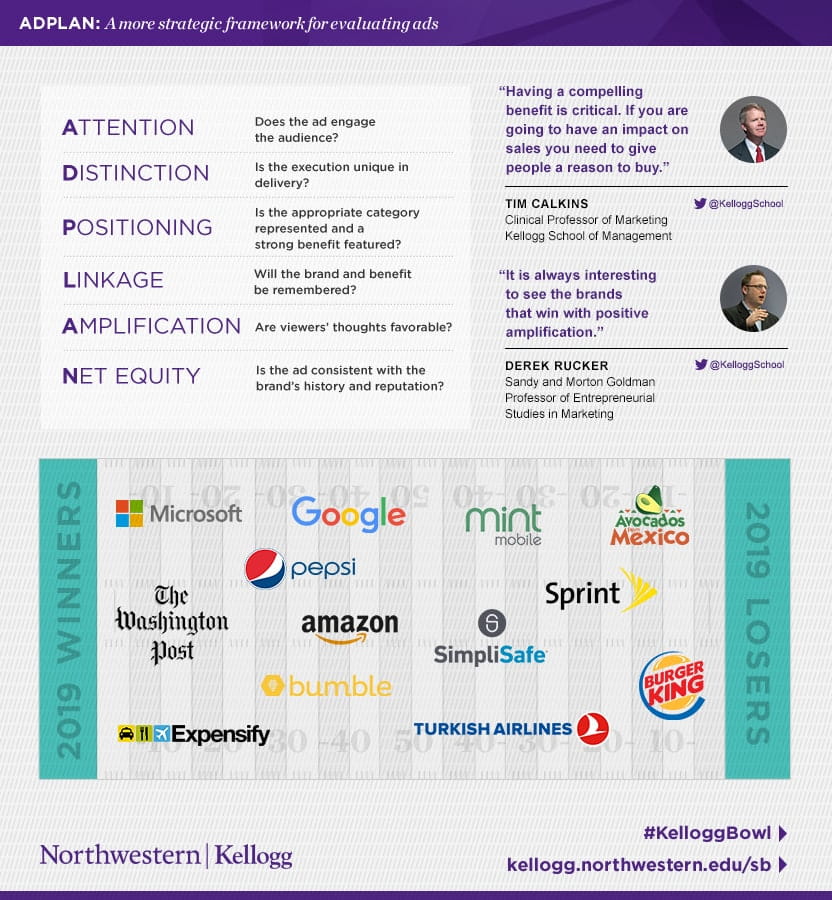


This is a rather different way to look at it as compared to more traditional media outlets which focus on "funny" or "entertaining" as beautifully depicted in the cartoon below.
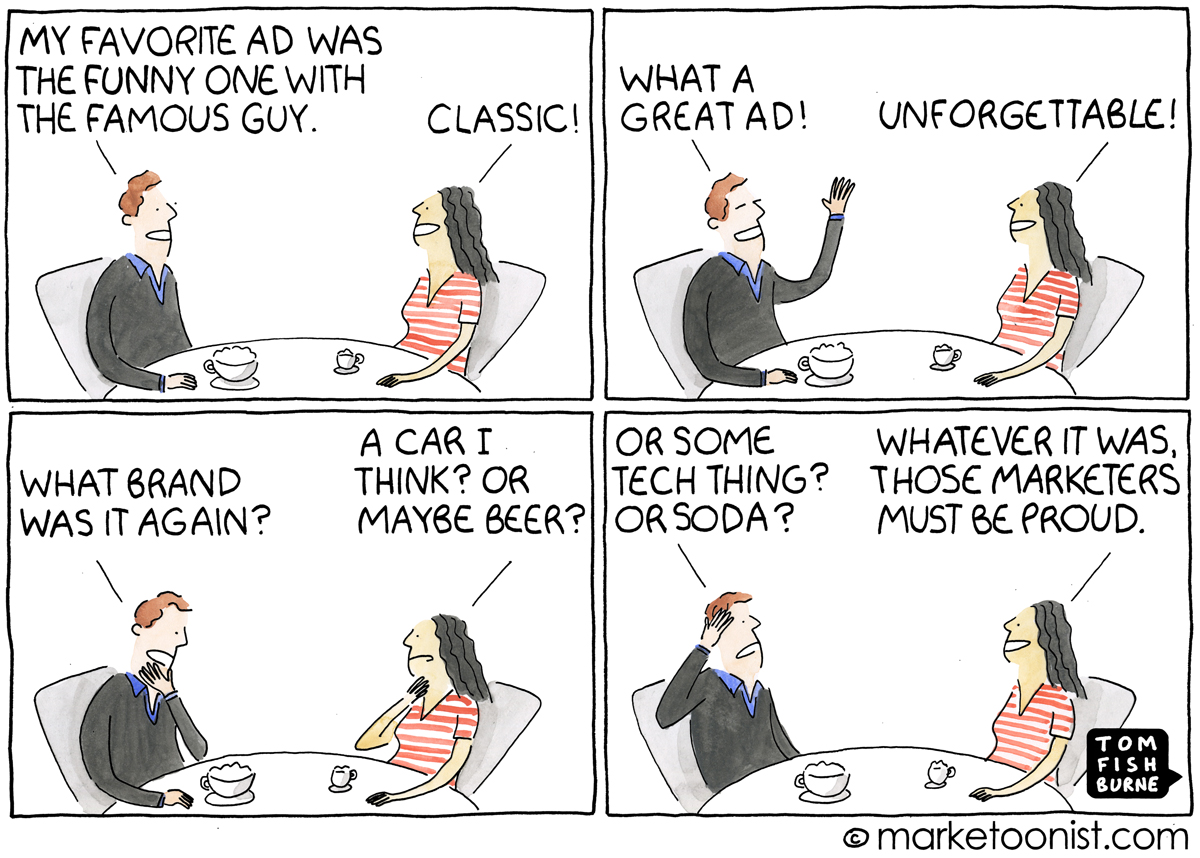
https://marketoonist.com/2018/02/super-bowl-ads.html 
This year, as I've done since 2016, I selected my 3 favorite ads and the biggest disappointment. Overall, I was not that impressed with the average quality of this year's ads. In any case, there were some gems and I hereby summarize them by using the Kellogg framework.

Microsoft 
I thought Microsoft did a brilliant job balancing an emotional topic without getting corny or over the top. A two-minute long spot grabs your attention with amazing kids with disabilities who are fun and living their lives witht he help of others as much as possible like any other kids. But that's also because of Microsoft Xbox Adaptive Controller. The positioning and linkage with the brand are very strong. An ad like this one when done well brings amplification and net equity.


Olay
This was a short and simple ad but very effective. It gets you interested to see where this is going and in a few seconds the brand is dropped and the benefit is right there. The actors brought a distinct aspect and fun. All in all, great job and extra points for being cost-effective.


Pepsi
That's such an insightful and bold ad. Who has never heard the phrase "is Pepsi ok?" when ordering Coke? Pepsi went heads on it and using a fantastic actor such Steve Carell makes statement: "it's much more than OK". It could've given a bit more info why it's more than OK. But that did not take away the brilliance of the execution of a distinct and positive ad for Pepsi.


Honorable mentions: Stella Artois, Pringles and Skechers 

Apparently the Kellogg panel found Expensify and Bumble were top ads. Maybe it's a cultural thing or I'm far from the target audience, but I failed to see a good positioning and linkage in those ads.

Disappointment: Burger King
I have no idea what's the benefit, the positioning and it is very boring.

You can watch all commercials here.
For more on Kellogg's ADPLAN

Tuesday, February 6, 2018

SUPER BOWL ADVERTISING: My top 3 Commercials of 2018

Every year since I went to Kellogg, I follow the Kellogg School Super Bowl Advertising Review which uses a strategic academic framework known as ADPLAN to evaluate the effectiveness of Super Bowl spots. The acronym instructs viewers to grade ads based on Attention, Distinction, Positioning, Linkage, Amplification and Net equity.


This is a rather different way to look at it as compared to more traditional media outlets which focus on "funny" or "entertaining" as beautifully depicted in the cartoon below.
https://marketoonist.com/2018/02/super-bowl-ads.html 
This year, as I did in 2016 and 2017, I again selected my 3 favorite ads and the biggest disappointment. I hereby summarize them by using the Kellogg framework.


Tide
I thought Tide did a brilliant job and rather innovative. A first long spot setting the scene and then very interesting short spots to keep it on top of our minds. It grabbed the attention and it was unique. It also positioned Tide in its category with strong branding. The befit was clear, but it could be stronger. People will certainly remember this spot that paid homage to classic P&G ads and uses a strong actor.

Rocket Mortgage
I really liked the linkage and positioning provided by this simple but effective ad. The benefit is clear: "makes the complex simple" and while the brand only shows at the last 15 seconds, it comes strong on the scream and voice over. At that point the positioning is also clear.  It is an attention grabber but it's not super distinctive and amplification is not that high. All in all, great job.


Sprint
Building on the West World /AI hype, the ad grabs the attention from the start and becomes very distinctive. The benefit (paying more for the same) , positioning (framing against Verizon) and branding are very clear before even reaching the second half of the ad. The second half uses humor to improves amplification and the ad closes by coming back to the brand and benefit.


Honorable mentions: Avocados, Jeep, Pringles and Wix.

Apparently the Kellogg panel found Amazon and Mountain Dew / Doritos were top ads. Maybe it's a cultural thing or I'm far from the target audience, but I failed to see a good positioning and linkage in those ads.

Disappointment: T-Mobile
There's a T-Mobile logo during the whole ad and that's about it. I have no idea what's the benefit, the positioning and while grabs the attention, it is kind of boring.


You can watch all commercials here
For more on Kellogg's ADPLAN

Sunday, October 15, 2017

Uber faces challenge from car-booking app backed by Chinese or not really?

Last weekend I read the following FT newspaper article: Uber faces challenge from car-booking app backed by Chinese. It is talking about Taxify, which already operates in 19 countries, and it is opening in London with "the aim of taking thousands of drivers and passengers away from Uber". While reading the article my biggest question was, why would a Uber customer switch to Taxify anyways? The article offered only one answer to this question: lower price.

Taxify founder and chief executive Markus Villig is quoted in the article saying that he expects the business to get up to 50 per cent of the London market for ride-booking by undercutting Uber on price, but paying higher rates to drivers. That sounds like a double negative hit on their P&L. I'd be curious to see their business plan.

When your marketing objective is acquisition of customers, you have basically two options, convert non-users by stimulating demand or earning share from the competition. Therefore based on what I read, Taxify is going to earn share from Uber by differentiating on price. That is an older strategy than marketing itself, but it's also a low profit and high risk strategy. And to even work, market research must have shown that the answers to two key questions: "Why do they use Uber? What would make them switch?" are price and cheaper offering, respectively.

Now the sustainability of such a strategy is even more risky if you take into account that according to another FT article Uber makes vast losses — $3bn last year. FT states that Taxify aims to increase payments to drivers compared to Uber by charging lower commission, of about 15 per cent. It could be that Taxify expects to "recruit" the majority of the drivers and therefore improve their customer KPIs (waiting time, response rate, etc). But that's never mentioned.

While I do believe in competition and would be happy to see other players competing with Uber, I don't think that a price cut as strategy is sustainable in the long term. It's important to notice that Mr. Villig believes that Uber is profitable in developed countries such as the UK. But even so, a solid strategy should be based on sustainable competitive differentiation. Unless Taxify has a very different business and/or operating  model from Uber. One that allows Taxify to charge less and still be profitable (for example, like Walmart or Dell supply chain capabilities  allowed them to be profitable at lower prices and at the same time almost impossible to copy).

And then there's the discussion on self-driving cars and that will certainly disrupt the business model, but I'll leave that for another time. You can read more about it here:
https://www.cnbc.com/2017/05/24/goldman-sachs-ride-hailing-companies-will-dwarf-taxis.html
https://seekingalpha.com/article/4031752-will-uber-ever-make-money-bezeks-daily-briefing

Disclaimer: I'm no expert in this industry and I solely based this blog entry on the referred publications. 

Thursday, June 22, 2017

"You're either at work and dead, or you're living"

Today I want to reflect on the concept of Work-Life Balance (WLB).

Back when I was doing my MBA, I remember talking to my professor and former Baxter CEO Harry M. Kraemer who said “this phrase (WLB) sounds like you are either working OR living, and if work isn’t part of living, we may have a problem!”. Daphne Scott from DS Leadership Life has humorous spin on it: “The phrase "work-life balance" implies that you're either at work and dead, or you're living”.

Semantics aside, Mr. Kraemer further reflects on that in his book “From Values to Action” and refers to WLB simple as Life Balance. The book outlines his framework in which work and career is just one of the six buckets that each one of us must manage to achieve life balance. The other buckets being: Family and friends, spirituality, health (including sleep and exercise), fun and enjoyment, and being a “best citizen”, that is “making a difference” in the world.

While today I don’t want to advocate for semantics changes, I do think that the rationale behind this criticism is worth discussing. The first being that work is part of life and secondly that balance is open to interpretation.

It comes down to the fact that work is not just a means to an end. More and more employees are looking for jobs with meaning, purpose and aligned with their values. Our work is not separated from our lives, but it’s part of it and it needs to be balanced in face of the other important things in life (all buckets).

What about balance? Oxford defines balance as “a situation in which different elements are equal or in the correct proportions.” The key words for me here are “correct proportions”. The challenge is that everyone has a different version of his/her own proportions. There’s no “magic bullet” to solve it. You can only achieve Life Balance if you know what balance means to YOU. The proportion that you assign to each bucket is unique to you.

Whether you use the term work-life balance (I hope you don’t) or a substitute, the point is that high performance is driven by aligning our work with our values and higher purpose. You need to understand your core values, purposes and priorities so that you can create your own life balance which will include your work and career.

Monday, February 6, 2017

SUPER BOWL ADVERTISING: My top 3 Commercials of 2017

Every year since I went to Kellogg, I follow the Kellogg School Super Bowl Advertising Review which uses a strategic academic framework known as ADPLAN to evaluate the effectiveness of Super Bowl spots. The acronym instructs viewers to grade ads based on Attention, Distinction, Positioning, Linkage, Amplification and Net equity. This year, as I did in 2016, I again selected my 3 favorite ads and the biggest disappointment. I hereby summarize them by using the Kellogg framework.


Febreze 
This ad was truly engaging with good narrator, cinematic score, and great images. Moreover, yes, it is kind of funny and first time you see it keeps you wondering "where this is going?". So yes, it's an unique delivery. A commercial about the break itself with unusual imagery. All of it build up to deliver the benefit" Febreze eliminates the stink after people do the number 2". Although the ad is long, the Febreze logo is displayed at the very beginning and comes back strongly at the end. Therefore, clear linkage.  The funny element and unusual topic (toilets, smells, #2) will certainly get people to talk about it. Finally, the ad is consistent with their brand.


Google Home
The ad engages the audience with an emotional touch, a catchy song and depicting family situations that we all (or at least Americans of several races and backgrounds) can relate to. It may not be the most distinct ad but for the reasons above it does it sufficiently. We can clearly spot the category and their goal is to introduce the product. We clearly get a glimpse of the benefits of the product can offer. Within 15 seconds the brand name "Ok Google" is mentioned and we see the product in action. It's very clear what this ad is all about. The emotional and personal touch will make this ad memorable to the target audience. And it's pretty consistent with the Google image. Great product intro!


Ford
Great ad as well, some interesting and funny situations that most of us can relate to. It does grab the attention. The humor, the images,good song but specially the award situations make the ad unique enough to stand out. The key here is that the category is auto makers and not a particular car brand. In that category Ford position themselves as a company of the future which is and will continue to deliver benefits to customer via a series of specific products/examples (beyond the car itself). The logo is always at the screen corner, is part of several scenes  and when the voice enters the commercial, the narrator immediately tell us this is Ford and what they are doing. Clear brand linkage. It's a positive and interesting add that will get people to talk about it, specially because brings up self-driving cars.  Great ad to build the corporate brand further. 


Wix.com
Now I want contrast my favorite ads with a weaker one. And like last year this is an interesting one because as a film, the Wix.com ad is great. But from a Marketing perspective, not perfect. The ad gets an A for attention grabbing, gotta give them that. Is it unique? Not necessarily, I mean, we all have seen an action movie before. But more importantly, there's a positioning problem while the category is described (tools to build a website), the benefit is totally unclear. Why should I use Wix.com instead of another option? What benefits will it bring me to do that in "the disruptive world"? And the ad is so packed with action that the brand gets diluted (even if they tried to avoid it). At times it makes you even wonder if the brand is actually the restaurant (Chez Felix). There will be amplification because the film itself is fun and with great action actors. But will it help build the brand further? Maybe a little bit, don't get me wrong, it's not all that bad. However, I think they miss a golden opportunity to instead of an OK ad make it a great one.


For more info on The Kellogg School Super Bowl Ad Review and the ADPLAN framework:
http://www.kellogg.northwestern.edu/news-events/superbowl/about/adplan-framework.aspx 

Wednesday, December 21, 2016

A Selection of Some of My Favorite Business Books

Coming from an engineering background and MBA in marketing and finance, those 4 books were an interesting eye-opener before entering the healthcare industry. However, I do believe that even for experienced professionals in this industry, those are very fun, entertainment and insightful reads. 

Complications, by Atul Gawande
This is a well-written book by a surgeon. It lays bare a science not in its idealized form but as it actually is―uncertain, perplexing, and profoundly human. It is an essential book for people working in the health industry who don't have a medical background. It builds the understanding of the medical profession.

Hard Sell, by Jamie Reidy
Another essential book for those entering the industry. The former sales representative from Prizer gives an interesting view of the world of pharmaceutical sales.  As my professor told me though "I certainly would not use this as a reference document or refer to it in an interview." Make it a guilty pleasure.

Billion Dollar Molecule, by Barry Werth
Here is a fascinating no-holds-barred account at the drug development process and the business of science. For people working on commercial roles and dealing with bio-tech startups, Barry Werth chronicles give an interesting insight of this side of the industry.  

The Truth About the Drug Companies, by Marcia Angell
For those working for pharmaceutical companies this book gives the opportunity to "put yourself in someone else's shoes". Someone that believes that the entire industry is hopelessly corrupt:  the drug companies, the FDA, universities, physicians and all the rest. Honestly it's hard to read because the arguments are mostly flawed but the truth is, several people think like Marcia Angell, and the industry needs to be aware of how they think.

There are many Marketing books I love, but they may be specific to situations and needs. So I'd highlight two key ones that are broader in their applications

Kellogg on Marketing, edited by Dawn Iacobucci 
This is a great collection of articles on marketing written by the faculty at Kellogg.  It is a great refresher of the basic marketing concepts and while a bit old it remains very relevant.

The 22 Immutable Laws of Marketing, by Al Ries and Jack Trout
This book is very basic and the examples are quite old which makes the point how the fundamentals of marketing will always remain the same. For the busy bees out there, you can read it during one flight and it will become a reference for life.

Marketing is about customer insights and fundamentally it's about understanding human behavior. I have read several books in this area, for example "How We Decide" and "How Doctors Think" but...

Predictably Irrational, by Dan Ariely
It's one of my favorite books. I actually need to find the time to read it again. It's so insightful and yet fun to read. Dan Ariely explains why people act in seemingly irrational ways, proving his point with several interesting studies.

On the leadership development side, there are so many great books, let me try to focus on only four.

Good to Great by Jim Collins 
A management classic, the book showed how great companies triumph over time and how long-term sustained performance can be engineered into the DNA of an enterprise from the very beginning. 

Authentic Leadership by Bill George
Former chairman and CEO of Medtronic, Bill George makes the case that authentic leaders of mission-driven companies will create far greater shareholder value than financially oriented companies. 

Discover Your True North by Bill George
This best-selling leadership classic enables you to become an authentic leader by discovering your True North. It's basically a practical guide on how to become the authentic leader as described by Bill George himself on the previous book.

From Values to Action: The Four Principles of Values-Based Leadership by Harry M. Kraemer
My MBA professor and former CEO, Harry M. Kraemer wrote this practical guide book based on his popular Kellogg MBA course on values-based leadership. And it serves me as a reminder and guide of what I learned back then. 

Tuesday, October 25, 2016

Customer Services evolving and thriving via social media: My KLM Experience

We all remember the tragic events that took place at the Brussels Airport on March 22nd, 2016. I had a flight scheduled for March 26th with departure from the same airport. It was a flight with a connection before my final destination. One day after the attacks, I had no idea if the airport would be operational in the next days. But I knew that the flights were not officially cancelled. When thinking about what happened in such a familiar place to me and so recently, there was no way that I would want to go there if not absolutely necessary.  In my case, it wasn't because I could drive to where I had a connecting flight and skip the first leg of my trip. Consequently I would avoid the Brussels airport, assuming it would be even operating. Now, of course we can't just do that without contacting the airline because the system will automatically cancel your whole ticket if you don't check in to take the first flight.

Before going any further I have a confession to make. Even though I love technology, I do not put myself under the "innovators" area of the classic technology adoption curve. For most situations, I am probably under the later part of the "Early Adopters". And even though I fully adopted Social Media in my personal and even professional life, the idea of making contact with customer services to discuss a complex ticket change seemed not feasible.

As a consequence, my first natural reaction to solve my KLM flight dilemma was to use the good old phone to call customer services. Well, that didn't go as I planned, given the critically of the situation and the high level of emotions, I had no doubt in my mind that KLM would change my ticket immediately and without any costs. To my surprise, the polite and nice lady on the other side of the line, cordially told me that she was not authorize to do that without charging me a huge re-booking fee. At that point I asked if there was any superior person that I could talk to because I couldn't believe in what I was hearing. But no, she said to call "tomorrow".

That's when I noticed that all over the e-mails and their website, KLM was advertising that we should "contact them via the new channels: Your questions answered 24/7 within 1 hour via Facebook and Twitter". Immediately after hanging up the old and archaic desk phone, I tried Facebook and the response and efficiency astonished me! Within 1 hr, they found my reservation based on my Facebook name and informed me that they could make the change with no problem. We started to chat with private messages and the problem was solved within hours and just a bit of typing.

My experience highlight many of the basic foundations that a company need to put in place when they open their social media channels as a customer service tool. Time is of essence and to get there you need the tools, capable personal and monitoring to track messages and timely answer them with a personal touch and in a meaningful way. An automatic message like "thanks for your question" would have been devastating for the brand.

But most importantly, when a customer is dissatisfied with your brand, everything depends on your response. When I went to Facebook to complain about the phone service, I was directly sending a negative feedback to KLM. While for some this is a threat, for smart companies is an open invitation to rectify your brand's image and, more important, your relationship with the customer. I felt like I was heard and my problem was taken seriously. KLM did what it had to do to keep me a happy customer, despite the difficult circumstances.